Characters
When I finished Paper Towns a week ago, I was completely astonished at how the characters developed, undeveloped, and redeveloped again. This characterization could be found as absolutely flawless, or just plain lazy. The dynamic characters of the book did not go through one major change. Instead, they went through three or four major changes that left them completely different people.
"'You had been a paper boy to me all these years- two dimensions as a character on the page and two different, but still flat, dimensions as a person. But that night you turned out to be real." (Green 292)
John Green, in this novel, doesn't give any definite characteristics: it's up to the characters to interpret the other characters based on their actions, and they never know if they're right or not. The characters continue to create images and expectations of the others, rendering them two dimensional. Once people get past their assumptions, they can find all three dimensions inside of other people and even themselves.
The character I will talk about is Margo Roth Spiegelman. The most unique thing about this character is that every single person she knows sees a different version of her. This blew me away because it displayed accuracy about how people see the world, instead of how authors or readers see characters: very two dimensional, or "paper", as Margo would say. The novel emphasizes the fact that everyone is three dimensional when it comes to personalities, and nobody views you in the same way, no matter who you are. Right as someone thinks they might have the slightest grasp on who you are, another dimension shows. It even explains that sometimes, you don't even know who you are.
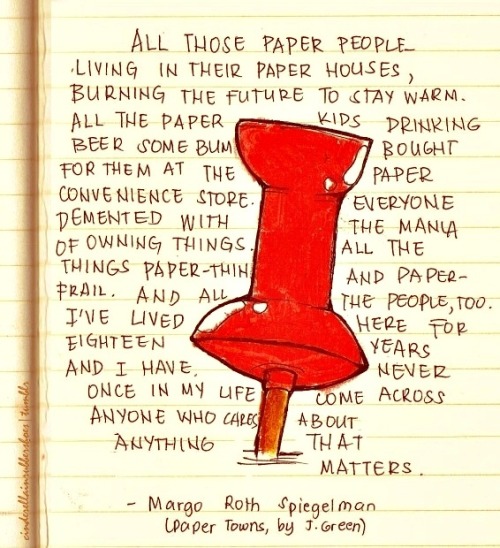
Margo's Development
The reason I chose to speak about Margo is that she barely develops in this entire story: it's the point of view of Q that gives the illusion of her changing. Underneath what people see, Margo has been the same all along, changing when she wants to, not when others want her to or see her differently.
"The fundamental mistake I had always made- and that she had, in all fairness, always led me to make- was this: Margo was not a miracle. She was not an adventure. She was not a fine and precious thing. She was a girl." (Green, 199)
This quote explains that people build expectations of others based on what actions they make, however inside they're just a person and they are simply them, no matter what images come into your head when you think of them.
Margo's Interaction
"Maybe things would have been different if I just hung out with you guys and stopped caring about my, quote, friends." (Green 58)
Margo has never really known what to say, and know that she feels sure of herself she shares these feelings with Q, making him feel as if she preferred him over others. This made him feel as if it were his responsibility to go after Margo once she went missing.
How Margo Enhances the Plot
Margo not only enhances the plot, but she is the plot. The story is revolving around Q's adventures to find her and discover who the real Margo is.
When I finished Paper Towns a week ago, I was completely astonished at how the characters developed, undeveloped, and redeveloped again. This characterization could be found as absolutely flawless, or just plain lazy. The dynamic characters of the book did not go through one major change. Instead, they went through three or four major changes that left them completely different people.
"'You had been a paper boy to me all these years- two dimensions as a character on the page and two different, but still flat, dimensions as a person. But that night you turned out to be real." (Green 292)
John Green, in this novel, doesn't give any definite characteristics: it's up to the characters to interpret the other characters based on their actions, and they never know if they're right or not. The characters continue to create images and expectations of the others, rendering them two dimensional. Once people get past their assumptions, they can find all three dimensions inside of other people and even themselves.
The character I will talk about is Margo Roth Spiegelman. The most unique thing about this character is that every single person she knows sees a different version of her. This blew me away because it displayed accuracy about how people see the world, instead of how authors or readers see characters: very two dimensional, or "paper", as Margo would say. The novel emphasizes the fact that everyone is three dimensional when it comes to personalities, and nobody views you in the same way, no matter who you are. Right as someone thinks they might have the slightest grasp on who you are, another dimension shows. It even explains that sometimes, you don't even know who you are.
Margo's Development
The reason I chose to speak about Margo is that she barely develops in this entire story: it's the point of view of Q that gives the illusion of her changing. Underneath what people see, Margo has been the same all along, changing when she wants to, not when others want her to or see her differently.
"The fundamental mistake I had always made- and that she had, in all fairness, always led me to make- was this: Margo was not a miracle. She was not an adventure. She was not a fine and precious thing. She was a girl." (Green, 199)
This quote explains that people build expectations of others based on what actions they make, however inside they're just a person and they are simply them, no matter what images come into your head when you think of them.
Margo's Interaction
"Maybe things would have been different if I just hung out with you guys and stopped caring about my, quote, friends." (Green 58)
Margo has never really known what to say, and know that she feels sure of herself she shares these feelings with Q, making him feel as if she preferred him over others. This made him feel as if it were his responsibility to go after Margo once she went missing.
How Margo Enhances the Plot
Margo not only enhances the plot, but she is the plot. The story is revolving around Q's adventures to find her and discover who the real Margo is.

Sounds like a great book. It seems like it will really make you think and put your imagination to work.
ReplyDeleteI really like the way that you organized this post. Also, the wording of your post is very natural yet fun to read. It sounds like a very good book :) BTW i love your URL!!
ReplyDeleteI've read this book before! I think it's the best one of John Green's works. Loved how organized this post was. Do you like Paper Towns better than Looking for Alaska?
ReplyDeleteI liked the perspective and message more in Looking for Alaska, but overall, I enjoyed Paper Towns more. :)
DeleteSounds interesting! How do you have characters undeveloped? I am really interested in this book and what you thought of it.
ReplyDelete-Nina
It's as if the character isn't who you think they are, so they kind of go backwards and become less developed and more mysterious. Pretty hard to explain. :)
DeleteSounds like an interesting book!!!!! I love how you organized your post!!! You make me want to read it!!!! I like the picture you put into your post!
ReplyDeleteI love that your post is very organized and neat and the book sounds really good! Margo seems like an interesting character. :)
ReplyDeleteSounds like a really good book just from the way you described the characters. Really shows you put a lot of effort and thought into your post. So anyways, good job with the posting!
ReplyDelete