Saturday, May 17, 2014

Setting in The Mark of Athena

After viciously devouring "The Son of Neptune" in less than 24 hours, I moved on to the Mark of Athena, the 3rd book in the Heroes of Olympus series.

Naturally, I need to catch up on blog posts and I saw the perfect opportunity to talk about setting right at the beginning.  Riordan describes the Roman demigod camp, "Ringed by the Oakland Hills, the valley was at least twice the size of Camp Half-Blood.  A small river snaked around one side and curled toward the center like a capital letter G, emptying into a sparkling blue lake" (7).

Not only did Riordan use many action verbs to make the scene appealing, he later goes on to describe it with detail that actually plays a part later on in the story.  Not to mention there's an official map for Camp Jupiter.


I mean dang.  An author with that much dedication to scenery deserves at least one admiring blog post.  Riordan hasn't yet fallen into the dark pit of continuity errors in all of the scenery he describes, which is super awesome.  Seriously, if you were writing an epic battle scene, would you be concerned on the effects on the surrounding area?  The author doesn't get carried away and often incorporates realistic effects to things not so realistic, such as a war between giants and kids who are half god.  This is just one of the components of writing Riordan wields to his advantage.  He recognizes that when you're reading of a new universe, scenery matters, and I cannot thank him enough for this thought and effort into setting.  

Son of Neptune? Poseidon? Or Just Good With Water?

Percy Jackson.

He's wiggled his way into many readers' lives.  His crazy character once again appears in Rick Riordan's second installment of the Heroes of Olympus series.

There are many words to describe Percy.   Loyal, hardworking, dedicated, sarcastic, a tad insane.  But does Riordan ever really tell us this?

Whilst reading, I stumbled upon a very effective way that Riordan shows character, and that's through dialogue.  Percy says, "You think I'd leave my team behind?  After surviving Fleecy's wheat germ, running from cannibals, and hiding under blue giant butts in Alaska?  Come on!"  (Riordan 604)

Anyone who hasn't read this series can now agree with the few words I used above to describe Percy, and only with one quote.  The message is clear and for the taking without saying it dully, and you get a closer connection to Percy himself.  Too many times have authors tried to form their characters into words: Riordan simply uses words to form characters.

Fulfilling requirements is tedious when the author doesn't talk much about his latest series, so this is a fan-made trailer compiled of miscellaneous clips that's just generally awesome.  Voldemort makes a cameo.


Friday, May 16, 2014

Suspense in The Lost Hero

Suspense.  The first thing I think of is, naturally, the Jaws theme song.  

Currently I'm reading Rick Riordan's The Lost Hero and I can't help but connect it with the well known "song". 

Riordan is fabulous, that much is true.  But why?  What makes his books so compelling to read?  What makes the cliffhangers so dangerous?

He does exactly what I just did: he has the characters outright ask questions.

One example of this is when Piper is dreaming, "The only question now- will you die with your friends, or live with your father?" (Riordan 106)

Often times I'd find these bits a little outright, but soon I realized that this is important.  Riordan constantly reminds you what you're reading for, which is really helpful towards his goal of suspense.  Since you get swept up into the story, it's nice to have something that the author basically outright says he wants the reader to think about.  

Overall this book has been a great read and I'm looking forward to The Son Of Neptune, which is next in the series!

Thursday, May 1, 2014

Can Curlers + Girdles + Vaseline = Popular?

Popular: Vintage Wisdom for a Modern Geek.

To be quite honest, I cringed at the name.  I mean really: me?  Care about popularity?  Wait a minute... this isn't quite right.  Regardless, I looked into it further.  I highly doubt John Green would mention this book in his video if he found its greatest value was telling impressionable young girls being popular was important.  

As a matter of fact, this book was written by an impressionable young girl and also my name twin: Maya Van Wagenen.  An eighth grader (now 15 years old) girl came across a book in her father's office titled "Betty Cornell's Teen-Age Popularity Guide".  Maya is just like me (oh dear, this is going  to be awfully confusing) in that she doesn't really mind being unnoticed.  Her goal is to fold out a social experiment to understand what popularity is, but with a twist,  Her plan is guided strictly by ex-model Betty Cornell and her aged ways of gaining friends and meeting "model standards". 

The day I started reading this book was yesterday.  The day I finished this book? Yesterday.  How I managed to start and finish a book between miles of homework and the torturous lovely 8 hour school day is beyond me, but I decided to tell you guys anyway.  I suppose it's just another way to say this book will probably consume your life.  :D

I believe my favorite part of the book was its universality.  It's truly great for anyone who's concerned about popularity just as much as anyone who isn't.  The messages sent are directly from a wise teenage girl to anyone who would even consider opening her book.

Naturally, I must acknowledge that Maya has something we've all been on an epic quest to find during the adventure that is English 1B:

Writer's Voice.

I could analyze it for you, but just reading it for yourself is much better. 

 
This is one of her 10 "popularity tips" that show you what she's learned throughout her experience.  This tip perfectly encases her constant voice within her piece, even though it's a nonfiction book.
 
Overall this book was a quick but amazing read with lessons I'm sure a whole bunch could benefit from.  :) 
 
Happy Blogging!

Thursday, April 17, 2014

What Makes Harry Potter a Classic?

As a side note, if you're here because of a quad blog, scroll down!  It's more fun down there in the deep scary depths of whatever you call this.  Comment on one of the two I posted last week!  :)

As I finish up the Harry Potter series, the buzz still goes on.  Just yesterday my mom and I were talking about the characteristics of a classic, and why the whole series would be a shoe-in for class readings in the future.  This sparked my curiosity and I decided to talk about it in this week's blog post. 

According to random people on Google (yay!) a classic needs to hold up a few main components:

Morality
{{An author's statement on what's right or wrong on some sort of human problem.
Truthfulness
{{The author uses fact (nonfiction) or fantasy (fiction) to communicate basic human truths.
Universality
{{The story being taught should hold significant meaning everywhere.
Timelessness
{{The story being taught should hole significant meaning at all points in history.

If a book demonstrates all of these traits and is widely popular, it's likely to become a classic.  I believe that the whole Harry Potter series will become a classic and for the sake of post length I shall tell you why!

Morality: Harry Potter consistently shows that good triumphs over evil, but sometimes at great costs.  Overall it wants to tell you that some things are worth fighting for, which is an extremely important concept which you can apply to real life.
Truthfulness:  J.K. Rowling likes to communicate a lot of truths through her writing.  One is that persistence is the ultimate way to success, and you need to work at something to achieve it.
Universality: Harry Potter World is in Universal Studios.  Bam.
Not to mention the struggle between Muggle-borns and Pure Bloods is applicable to nearly every discrimination situation.
Timelessness: The ideas brought up in this story have been around for quite awhile, and I don't think they'll be leaving anytime soon.  Not to mention, a boarding school within a castle surrounded by a forbidden forest (unless you're in detention) would be extremely awesome at all times.  

Naturally, I envy all who have the chance of studying Harry Potter in school instead of books with 0% plot 100% character development.  :D  Happy blogging!

Sunday, April 13, 2014

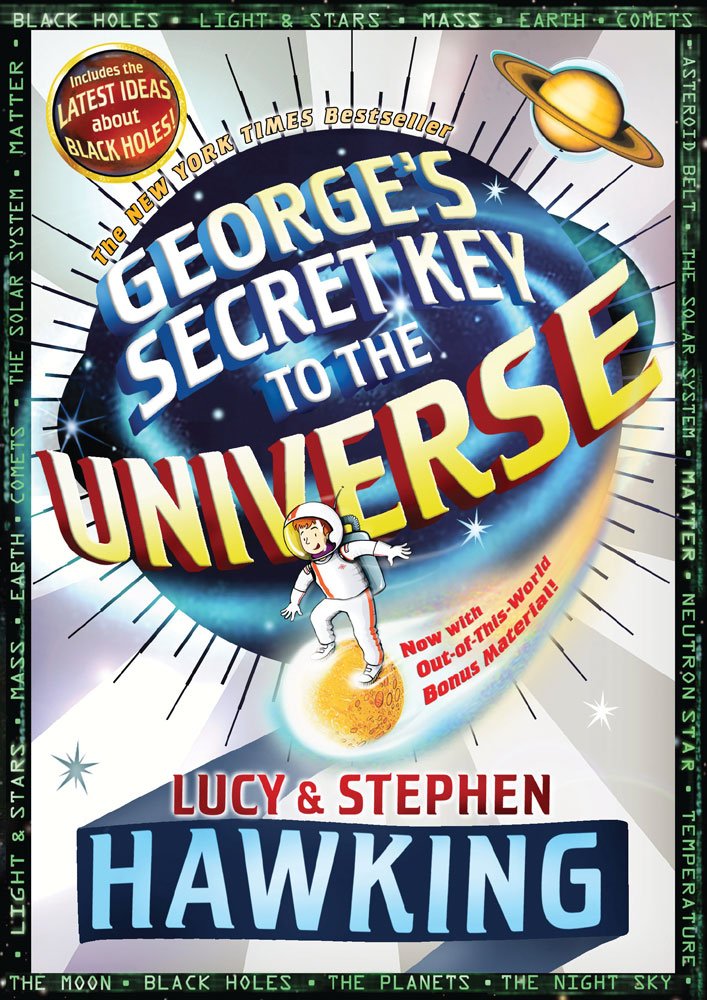
George's Secret Key to the Universe

Yes, before you ask: it is a real book.

Before I carry on though, my blog post from last week didn't post!  {world crisis ensues} Anyway, if you're a Harry Potter fan, scroll down a little!  I talked about all sorts of symbolism!!

Ok, so I admit, I've been on a reading dry spell lately, so I've been looking into some of Stephen Hawking's works.  (What better way to spend your time?)

I recently came across a book co-written with his daughter, titled George's Secret Key to the Universe.   It's a little childish, but very informative.  I haven't read that much, but I will tell you why I chose this book.

First things first: the cover.

Across a lovely holographic cover, the ultimate dominating word is "Universe".  The universe.  How cool, huh?  Even without a conscious thought, this cover was designed to spark your curiosity.

Naturally, the next step in your new relationship (aww) is reading the inside flap.  Here's what it says.

'Welcome,' said Cosmos, 'to the universe!'


When George's pet pig breaks through the fence into the garden next door, George meets his new neighbours - Annie and her scientist father, Eric - and discovers a secret key that opens up a whole new way of looking at the world. From outer space!


For Eric has the world's most advanced computer, super-intelligent Cosmos, who can whisk George and his friends off to any point in the universe. Suddenly George is on a rollercoaster ride through the vastness of space - past planets, through an asteroid storm to the very edge of our Solar System and beyond.


But someone else has plans for Cosmos - plans which will lead Eric and George into terrible danger.


And there is nothing in space more dangerous than a black hole . . .


This terrific page turner combines a gripping and funny adventure with lots of fascinating scientific facts about our universe and the planets, including the latest ideas about black holes from Stephen Hawking. Plus full-colour photos of real images from space!

It is clear that this book's target age is lower than mine, but who can resist black hole information from the renowned scientist himself?  I am eager to see what he has to offer and how it ties in with the story of a pig gone missing.  :)

Weekly question (this is a thing now I swear, see my previous post):  Have you ever read a book which blends reality and a story like this one?  Would you recommend one to your friends?

A Trip to the Past

{{Note: Somehow my blog last week didn't post??  Knowing me, I just saved it as a draft and never published.  My bad 100%}}

I don't think I'll ever forget the day I started the Harry Potter series.  My cousin stayed up the whole night prior to finish the Deathly Hallows, a book in which he camped out to receive.  I asked the fatal question that launched me into the ultimate classic children's series: "So... is that book good?"

The fall of my third grade resulted in my reputation of "crazy person whose read Harry Potter waaaay too much", and over Spring Break that's what I've been up to!

Right now I'm on the 6th book: Harry Potter and the Half-Blood Prince, but today I'll be talking about the fifth book The Order of the Phoenix, mostly because it has more to do with the prompt I chose.

While going through the torment of choosing a legitimate topic for this post, I took a stroll through the suggestions and it talked about determining a symbol for some of the characters.  Luckily, J.K. Rowling has helped immensely with that subject by already choosing for me, with the amazing idea of Patronuses.


For time's sake, I'll be explaining why Rowling chose these animals for the big three: Harry, Ron, and Hermione.

Harry's Patronus is a stag, which is interesting because it's one identical to his father's.  This is in reference to Harry's limitless similarities with his father.  As said throughout the series: "You look just like your father, except your eyes. You have Lily's eyes." (Rowling, 354).  His skills are often comparable to his fathers, as he shows promise in Quidditch and Defense Against the Dark Arts, as did James.  Stags are often seen as powerful and prominent figures, which aligns with Harry's role in the series.

Ron's Patronus is a Jack-Russel Terrier.  I found this really cute while researching because it turns out that these dogs, while very loyal, are also known for chasing down otters.  Since Hermione's Patronus is an otter and they get married in the epilogue of book 7, this is a prominent piece of foreshadowing which made me quite warm on the inside.  :)

Hermione's Patronus is an otter, and it's very clear why Rowling chose this.  Otters are known for being extremely inquisitive and problem-solving animals, which captures her personality in great detail.  


Overall, the idea of Patronuses in Harry Potter allowed Rowling to get more ideas across about her characters and make the book more enjoyable.

I know commenting really thoroughly on a blog post is just plain painful, so I've decided to ask you guys a question for the next few blog posts so you don't, you know, stop talking.  So what do you think your Patronus would be?  Why?